
A practical guide for homeowners, developers and rural property owners
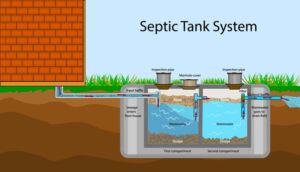
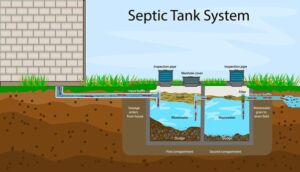
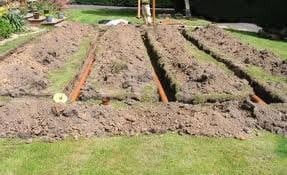
At Adkins Consultants, we are frequently instructed to advise on foul drainage solutions for rural and edge-of-settlement properties where ground conditions are less than ideal. One of the most common constraints we encounter is a high water table.
If groundwater is close to the surface, a conventional drainage field may be unsuitable – and if incorrectly installed, it can lead to premature system failure, pollution risk, and enforcement action.
This article explains how drainage fields should be designed where groundwater levels are high, and includes a worked example of sizing calculations.
Why High Groundwater Is a Design Constraint
A septic tank does not fully treat effluent. The drainage field provides secondary treatment through:
- Aerobic biological action within unsaturated soil
- Filtration through granular strata
- Controlled dispersal into the ground
Where the soil is saturated:
- Oxygen is absent
- Biological treatment is reduced
- Effluent may migrate directly into groundwater
- The system can surcharge in wet periods
The fundamental requirement is therefore:
There must be adequate vertical separation between the base of the drainage trench and the highest seasonal groundwater level.
Regulatory Framework
Drainage fields in England must comply with:
- Environmental Permitting (England and Wales) Regulations 2016
- Environment Agency General Binding Rules
- Building Regulations Part H
- BS 6297: Design and installation of drainage fields
Key requirements include:
- No discharge directly into groundwater
- Minimum 10 m from watercourses
- Minimum 50 m from potable water supplies
- Suitable soil percolation characteristics
Where separation distances or soil conditions cannot be achieved, an Environmental Permit may be required.
Site Investigation – Getting It Right
In our experience, inadequate site investigation is the most common cause of failure.
A proper assessment should include:
Trial Pits
- Excavated to at least 1.2 m depth
- Left open for 24 hours
- Groundwater level measured
- Soil horizons identified
Importantly, groundwater should be assessed during wetter months wherever possible, as summer readings can be misleading.
Percolation Testing
Percolation testing determines how quickly water drains through the soil and produces the Vp value (seconds per mm).
This value is fundamental to calculating the drainage field area.
Design Strategies for High Water Table Sites
Where groundwater is close to formation level, we typically consider:
- Reduced Depth Trenches
Shallower trenches with increased plan area.
- Raised Drainage Fields
Imported granular fill to elevate the invert level.
- Engineered Mound Systems
Pressure-dosed sand mounds where separation cannot otherwise be achieved.
- Package Treatment Plants
In some cases, upgrading from a septic tank to a treatment plant reduces environmental risk and may provide greater flexibility.
Each solution must be assessed in the context of site levels, proximity to boundaries, and long-term maintenance access.
Worked Calculation Example
Scenario:
Proposed 4-bedroom dwelling in a semi-rural location.
Percolation test result: Vp = 18 s/mm
Highest groundwater level observed at 900 mm below ground level.
Step 1 – Determine Design Population
Building Regulations assume:
- 2 persons for first bedroom
- 1 person per additional bedroom
For a 4-bedroom dwelling:
2 + 1 + 1 + 1 = 5 persons
Step 2 – Daily Flow
Typical domestic discharge = 150 litres per person per day
5 × 150 L = 750 litres per day
Step 3 – Calculate Drainage Field Area
BS 6297 uses:
A = P × Vp × 0.25
Where:
A = required trench floor area (m²)
P = number of persons
Vp = percolation value
So:
A = 5 × 18 × 0.25
A = 22.5 m²
Step 4 – Convert to Trench Length
Standard trench width = 0.6 m
Required trench length:
22.5 ÷ 0.6 = 37.5 metres
Therefore, the drainage field requires approximately:
38 metres of trenching
Step 5 – Check Groundwater Separation
If trench base is set at 600 mm below ground level:
- Highest groundwater = 900 mm
- Vertical separation = 300 mm
This meets the minimum separation requirement, but in marginal sites we would normally seek 450-600 mm where possible.
If this cannot be achieved, a raised system would be advised.
Practical Construction Considerations
From a surveying perspective, we frequently see failures due to:
- Installation during wet weather
- Smearing of trench sides
- Incorrect granular backfill
- No allowance for seasonal groundwater rise
- Surface water incorrectly connected
Careful setting out and inspection during construction is essential.
Long-Term Risk Management
In high groundwater areas, maintenance becomes more critical:
- Annual septic tank desludging
- Inspection of distribution chambers
- Monitoring for wet patches or odours
- Protection from trafficking and compaction
Professional Advice
High water table sites require more than a standard drainage detail copied from a drawing.
They require:
- Proper investigation
- Sensible engineering judgement
- Regulatory awareness
- Realistic assessment of seasonal conditions
At Adkins Consultants, we regularly advise clients on:
- Feasibility of septic systems
- Upgrading existing failed systems
- Expert witness matters involving drainage failures
- Compliance with Environment Agency requirements
If you are considering development on a constrained rural site, early professional advice can avoid costly redesign and enforcement issues later.